SCOPE Framework for Research Evaluation
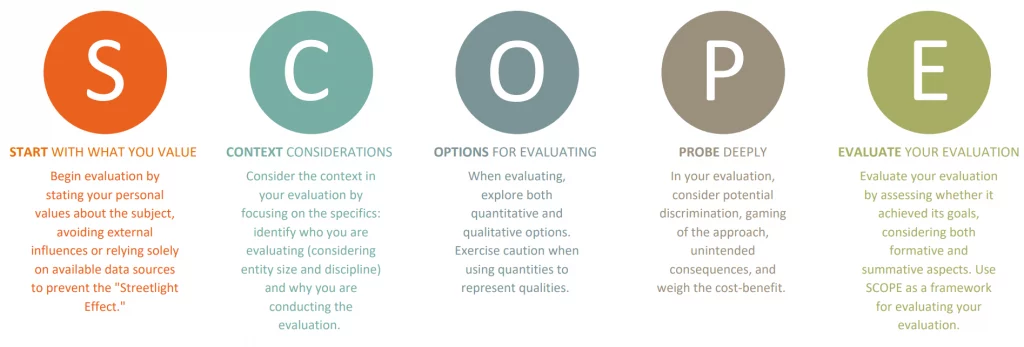
SCOPE is a five-stage framework for planning responsible research evaluations
and reviewing existing ones.
It gives research managers and others involved in evaluation a practical process
for considering what an evaluation is intended to achieve, how it should be undertaken
and how its effects can be assessed.
Principles of SCOPE
SCOPE provides a structured way to approach research evaluation. It helps those designing
an evaluation consider its purpose and context, explore the available options and examine
the consequences of the choices they make.
SCOPE resources
Guides and downloads
Videos
- Introducing the SCOPE process
- SCOPE Process for Research Managers — webinar, April 2020
Research and commentary
SCOPE in the press
Assessment reform advocate seeks shift from metrics overuse,
Research Professional, 20 February 2025.
SCOPE in practice
SCOPE has been used by universities, funders and research organisations
in a wide range of assessment settings.
University of Turku
The University of Turku’s 2023 policy sets out an institution-wide approach
to responsible assessment, including good scientific practice, equality,
fairness, diversity and differences between academic fields.
Loughborough University
Loughborough University used SCOPE as the basis of its 2023 statement
on responsible research assessment, supporting its approach to research quality,
impact and visibility.
UK Committee on Research Integrity
UKCORI used SCOPE in work to develop indicators of research integrity
for use by UK higher education institutions.
Newcastle University
Newcastle University used SCOPE principles in work to refine and align
approaches to evaluating research culture.
University of Reading
The University of Reading used SCOPE to develop a framework for assessing openness
and supporting longer-term change in open research practice.
Loughborough University — Evidence-Informed Output Narratives
Introduced in 2025, Evidence-Informed Output Narratives allow researchers
to draw on different forms of evidence of contribution, quality, peer validation,
reach and visibility.
View further SCOPE examples
- University of Surrey — developing open research indicators
- Indian research funding agencies — examining research assessment practices and broader assessment criteria
- International Science Council — exploring debates and developments in research evaluation
- University of Leeds — developing measures of research culture
- University of Glasgow — evaluating support for researchers’ careers
- Emerald Publishing — evaluating diversity on editorial boards
- Denmark — using SCOPE in interviews with higher education leaders
- Oslo Metropolitan University — teaching scholarly communication
- UK higher education funding bodies — work informing the Future Research Assessment Programme
- League of European Research Universities — next-generation metrics for research
- CYENS — development of a responsible, inclusive and impact-driven research assessment model
Making the case for responsible research evaluation
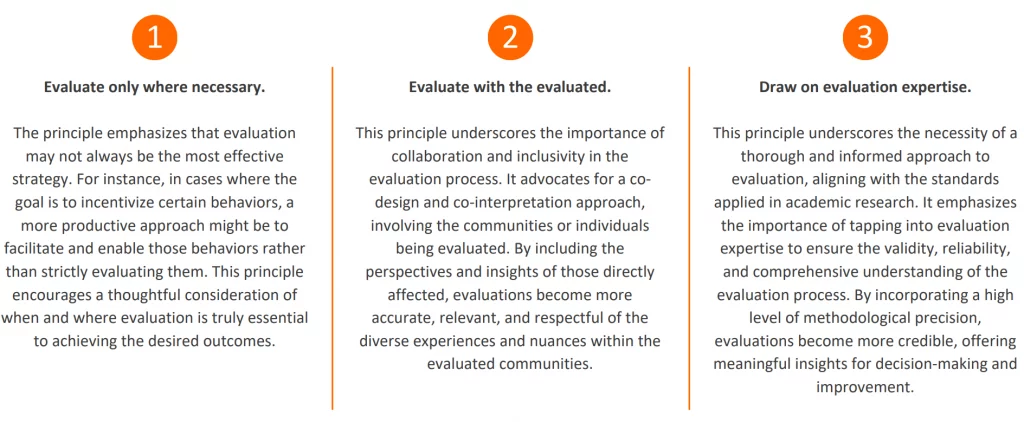
Research organisations contain substantial expertise in evaluation.
SCOPE encourages institutions to draw on that expertise when designing assessment processes
and deciding how evidence and indicators should be used.
REGA has produced five arguments to support conversations with institutional leaders
about responsible research evaluation.
SCOPE workshops
REGA can facilitate workshops using the SCOPE Framework for universities
and other research organisations.